
Criminal Court Cases in Dundy County
Dundy County divides its criminal docket between two courts. County Court hears misdemeanors and traffic matters, and it conducts the first stages of felony prosecutions. District Court is the felony trial court for Nebraska's 11th Judicial District. A felony can thus appear first in a County Court record and later proceed as a District Court case. The official county FAQ makes the same practical split for hearing dates: ask County Court about a County Court setting and the Clerk of the District Court about a District Court setting.
The clerk is the custodian of the filed case record. That file begins with the complaint or information and grows as the judge enters orders, the parties file motions, and hearings occur. It is distinct from the sheriff's incident report and jail booking file. A Dundy County arrest may never become a filed case, and an intake charge may change once the County Attorney makes a charging decision. Readers tracing the full path should treat court, sheriff, and state repository records as related but separate sources.
Dundy County Court Docket Routes
The first useful question is not simply whether a criminal case exists. It is which Dundy County court held the stage being sought. Misdemeanor judgments remain in County Court. A felony's initial appearance and preliminary proceedings may also begin there, while the felony trial file belongs in District Court after the matter advances. The offense class and the docket chronology help identify the correct counter.
The Nebraska Judicial Branch District 11 directory identifies the local courts and court officers. Its view of the district is shown below.
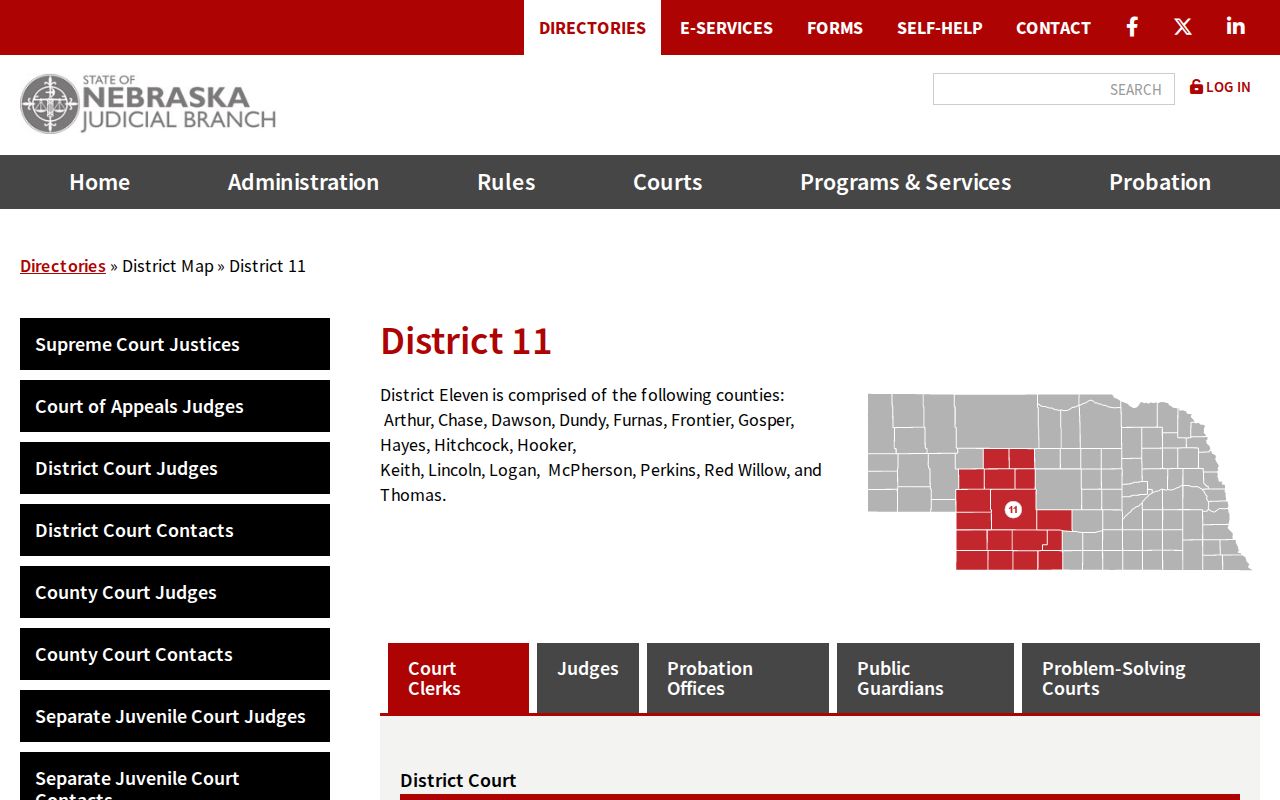
The directory gives a court-specific route when a name search is not enough. It also helps a caller avoid asking one clerk for a file held by the other court.
Dundy County Case Record Searches
JUSTICE Search is the statewide online starting point for Dundy County criminal cases. The one-time party-name option costs $17, returns up to 30 records, and keeps results available for three days. A subscriber account costs $100 per year for up to ten usernames. General result lists are free to subscribers, while detailed case, exact case-number, or judgment-date access costs $2. A public JUSTICE terminal at the Dundy County Courthouse is the no-cost alternative.
- Choose a person or party-name search and enter the legal surname. Add the full first and middle names when known.
- Select Dundy as the county. Use court type, case type, year, judge, or attorney filters when the service offers them.
- Compare results by court, filing year, and case chronology. A name match alone does not confirm identity.
- Open the detailed docket to review charges, register of actions, hearings, financial entries, and available document images.
- Contact the clerk that holds the case for a certified copy, an older file, or a document that the online index does not expose.
| Field Label | Type | Required | Options or Notes |
|---|---|---|---|
| Party Type | Selector | Unspecified | Use the person or party option on the live form. |
| Last Name | Text | Effectively needed | Enter the legal surname. |
| First Name | Text | Optional | A full first name helps narrow common names. |
| Middle Name | Text | Optional | Use it to distinguish similar names. |
| County or Court | Selector | Optional | Select Dundy for local cases. |
| Case Type or Date | Selector or date | Optional | Controls vary by service screen. |
A precise case number is the best key once it is known. For a new search, the Dundy County filter and full legal name reduce noise, while the filing year and court type help distinguish records that share a party name. Confirm the match from the sequence of charges and events rather than relying on one label.
Dundy County JUSTICE Record Limits
An online index is a locator, not a promise that every filing can be downloaded. The case summary may expose parties, criminal offenses, assessments, payments, register entries, and filed-document images. Still, an older or unscanned item may require the local counter. A sealed file, protected juvenile matter, or redacted document may not appear at all. Spelling, aliases, and a filing in another county can also defeat a narrow search.
The Judicial Branch explains its choices on the Case Information eServices page, pictured here.
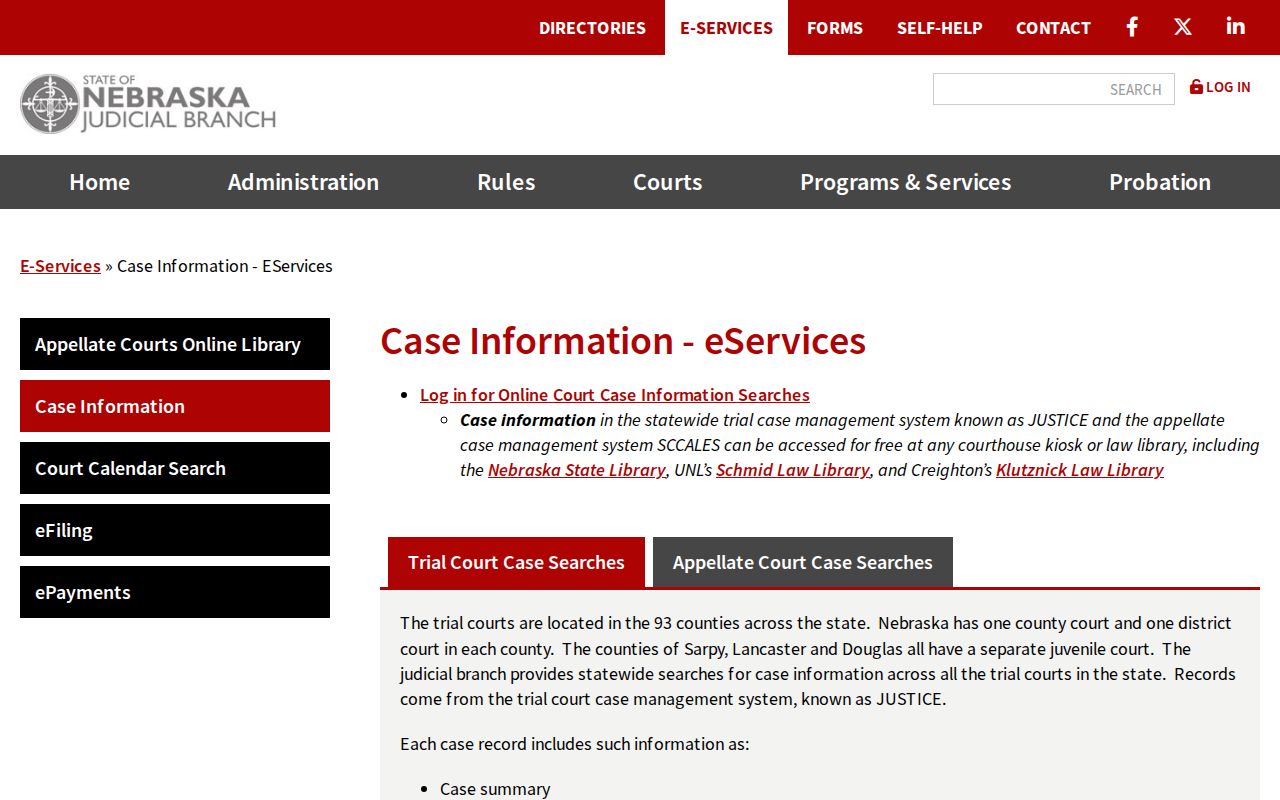
That menu helps separate paid historical searches from the free Multi-Court Case Calendar. The calendar covers settings, not a person's full case history. Its date search concerns current or future hearings, and its surname search needs at least two characters.
Note: No calendar result does not prove that no Dundy County hearing or criminal case exists.
What a Criminal Case File Contains
A Dundy County case file follows the prosecution rather than the booking. Its header identifies the case number, court, type, filing date, and status. Charge entries state the alleged offense, statute, class, count, and later amendments. The register of actions, often called a docket, puts filings and hearings in date order. Each disposition then shows how an individual count ended.
| Case Number and Court | The unique file reference, Dundy County venue, filing date, type, and status. |
|---|---|
| Parties | The State of Nebraska, the defendant, and attorneys when public. |
| Charging Document | The complaint, information, or other filed accusation and each count. |
| Docket Entries | A dated register of filings, motions, orders, and hearings. |
| Disposition | Whether a count was convicted, dismissed, acquitted, amended, or transferred. |
| Sentence and Financials | Public jail, prison, probation, fine, cost, restitution, and payment entries. |
| Documents | Images when available, subject to access limits and redaction. |
Terms matter. An arraignment is the formal appearance where charges and plea rights are addressed. A disposition is the way a count ended. A dismissal ends a charge without a conviction, while an acquittal is a not-guilty finding. A set aside is Nebraska relief under state law; it does not erase the historic file.
Dundy County Criminal Record Counter
Pandora Garcia is listed as Dundy County's Clerk of the District Court. The clerk's office handles the felony trial file and requests for certified District Court documents. The local page publishes a postal address, phone, and fax. County Court remains the proper source for its own misdemeanor and early felony records. Giving either clerk the case number, court, and exact document name makes a request more focused.
The official Clerk of the District Court page provides the current local contact channel.
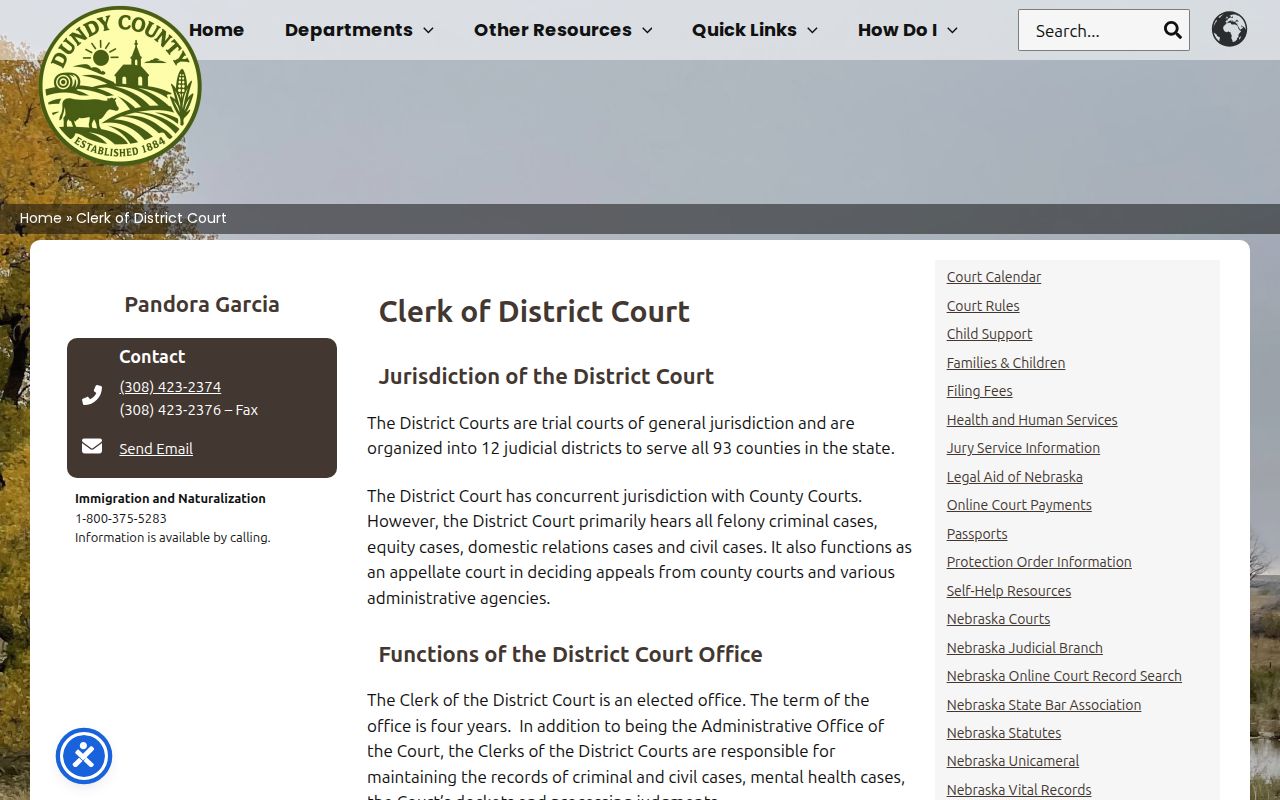
Use the clerk's page to confirm current counter details before a rural trip or mailed request. Ask whether the copy should be plain or certified and whether the requested filing is available online.
Clerk of the District Court
P.O. Box 378
Benkelman, NE 69021
308-423-2374
Fax: 308-423-2325
Criminal Case Stages in Dundy County
A court file starts when charges are filed, not at the instant of arrest. County Court handles the first appearance and other early work. A misdemeanor stays there. A felony that moves beyond preliminary stages proceeds to District Court, where later motions, a plea or trial, judgment, and sentencing appear. This transfer can create more than one useful case reference for the same chain of events.
Case flow: Charges Filed → Arraignment → Pretrial → Plea or Trial → Disposition → Sentencing
Filed charges can be amended, dismissed, or resolved one count at a time. Read the end of each count's chronology instead of assuming that the first allegation remained unchanged. The final judgment and sentence are stronger evidence of outcome than the charge shown at booking. For a fuller explanation of the intake side, the Dundy County arrest search follows the separate sheriff record.
Dundy County Discovery Record Rule
The county FAQ draws a firm line between public court access and discovery in a pending case. Discovery is evidence exchanged for the defense of a prosecution. A represented defendant should obtain police evidence through counsel and may need a court order. A self-represented defendant seeking their own police report must appear in person, show photo identification, reach arraignment, and decline counsel. The posted charge for that route is $0.25 per page.
This narrow rule does not grant access to another person's discovery packet. Nor does it replace a request for an open docket or judgment. Identify the capacity in which the copy is sought, then contact the office that holds it. The court clerk keeps filed pleadings and orders. The sheriff or other investigating agency holds the underlying incident report, subject to public-record restrictions.
Note: A Dundy County discovery request and a general public-record request follow different access tests and should not be combined.
Dundy County and Federal Court Records
Not every prosecution tied to Dundy County belongs in a Nebraska trial court. Federal charges are filed in the U.S. District Court for the District of Nebraska. The official docket and document system is PACER, which requires registration and applies the current federal fee schedule. A Dundy County JUSTICE search will not locate that federal case.
PACER's federal search entry is pictured below.
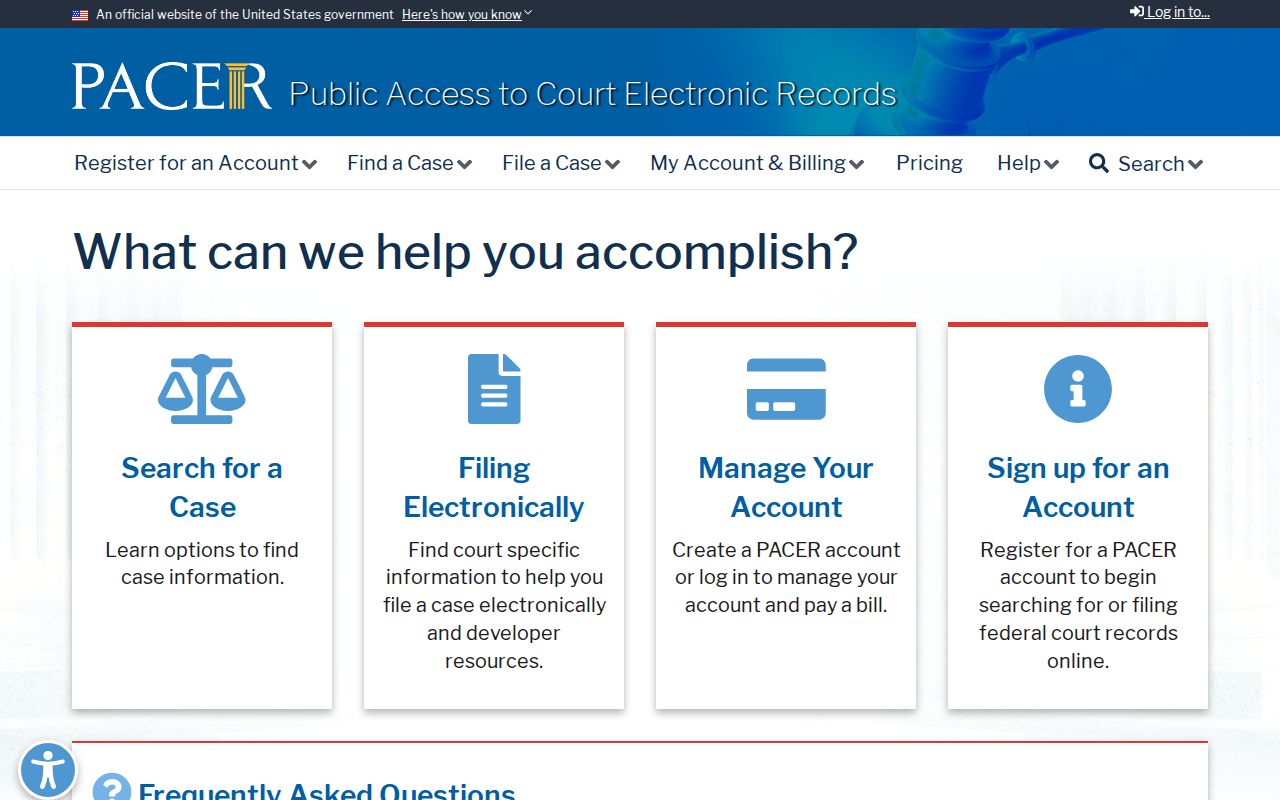
The separate federal layer matters when a docket names a federal agency or when no state filing matches a known federal prosecution. Federal custody is likewise outside the Dundy jail and Nebraska correctional locator.
Access Rules for Case Records
Nebraska's public-record inspection law supports access to government records subject to exceptions and cost rules. That does not make every part of a Dundy County criminal file public. Full identifiers, victim and minor information, medical facts, protected personal data, sealed material, and juvenile records can be withheld or redacted. Judicial Branch rules and case-specific sealing orders also control court access.
If JUSTICE shows a case but no document, ask the correct clerk whether the item exists, whether it is available at the counter, and whether a plain or certified copy can be supplied. If no case appears, check spelling, aliases, both local courts, and the possibility of another county or the federal system. A denial under the Nebraska Public Records Act should state its legal basis, and section 84-712.03 provides review routes.
A careful reader also separates a missing record from proof that no case exists. Restrictions, timing, and incomplete digitization can all affect the public view. The originating clerk remains the best source for confirmation.